
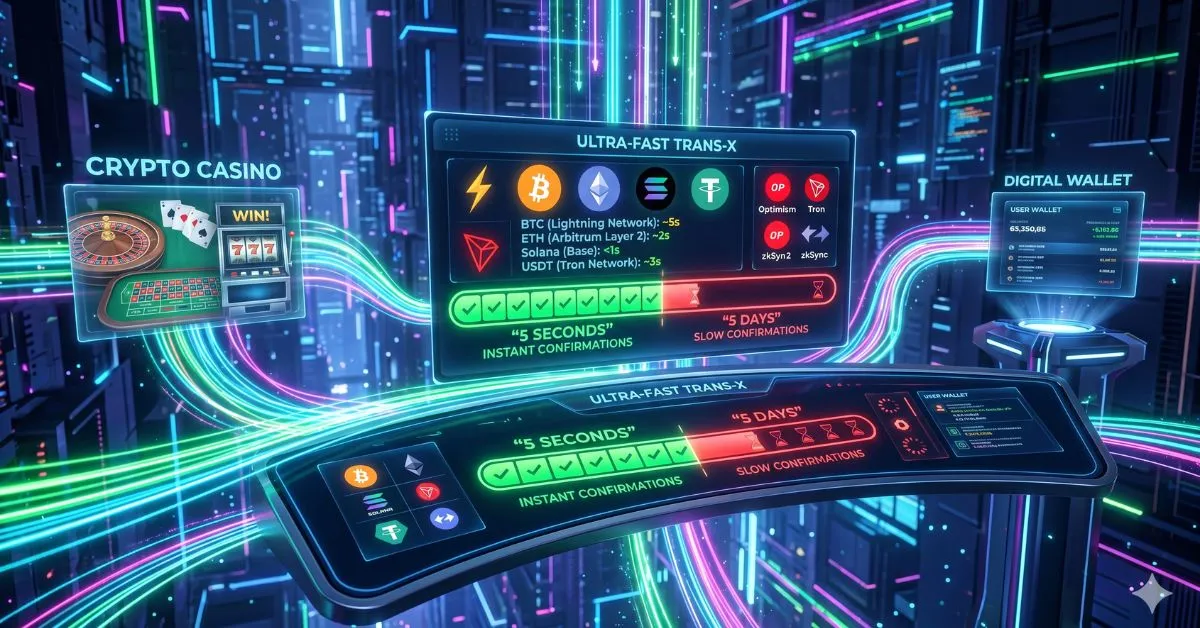
The biggest reason players switched from fiat to crypto gambling was not privacy, not bonuses, and not avoiding payment processor declines. It was speed. A traditional bank wire withdrawal from an offshore casino can take 5 to 14 business days. A properly configured crypto withdrawal settles in under a minute. That 1000x speed advantage is the entire pitch.
But here is what the marketing leaves out: crypto transactions are only instant when the casino, the coin, and the network all cooperate. Choose the wrong coin, use the wrong network, or pick a casino with a manual approval queue, and your “instant” crypto payout turns into a 48-hour wait that nullifies the whole advantage.
This pillar covers exactly what makes crypto transactions fast or slow, which coins deliver real speed versus marketing-speed, which network choices matter most, and how to identify instant withdrawal crypto casinos that actually deliver on the promise.
What “Instant” Actually Means in Crypto Gambling
The word instant gets used carelessly. A real crypto casino withdrawal involves three separate stages, and the delay can happen at any of them.
Stage 1: Casino approval. You click withdraw. The casino’s internal system reviews the request. On automated platforms, approval is instant. On platforms with manual review (most KYC-required casinos), this step takes 15 minutes to 72 hours.
Stage 2: Broadcast to the blockchain. The casino signs the transaction and broadcasts it to the network. This step is always fast (sub-second).
Stage 3: Network confirmation. The blockchain processes the transaction and includes it in a block. Confirmation time depends entirely on which coin and network you chose.
A truly instant crypto payout means all three stages complete in under a minute. Most “instant withdrawal” marketing refers only to stage 1 (automated approval), which is meaningless if you then picked a coin that takes 30 minutes to confirm on-chain.
The Five Variables That Determine Your Withdrawal Speed
1. The casino’s approval workflow
This is the single biggest variable. Casinos fall into three categories:
Fully automated: Withdrawals are approved by system logic based on account age, wagering completion, and risk scoring. Most no-KYC crypto casinos operate this way. Approval is sub-second.
Risk-based review: Small withdrawals are automated, large ones require human approval. Common on hybrid KYC platforms. Approval ranges from instant (small amounts) to 24 hours (large amounts).
Manual queue: Every withdrawal goes through a human review team regardless of size. Common on traditional casinos that added crypto as an afterthought. Approval takes 12 to 72 hours and is the single biggest source of “crypto casino payout delay” complaints.
How to identify each before depositing: look for the casino’s published withdrawal processing time. Anything stating “up to 24 hours” or “pending review” is almost certainly manual queue. Automated platforms advertise “instant” specifically because they can deliver on it.
2. The cryptocurrency you chose
Different coins have dramatically different confirmation speeds. This is the difference between a 5-second payout and a 30-minute payout, and casinos rarely explain it.
3. The network layer
Many major coins now run on multiple networks with very different speed and fee profiles. Bitcoin on-chain versus Lightning is the most obvious example, but USDT on Tron versus Ethereum versus Solana also matters massively.
4. Network congestion
Blockchain networks have variable throughput. Bitcoin gets congested during bull markets, Ethereum during NFT mints or major DeFi events, Solana during meme coin frenzies. A transaction that normally confirms in 10 seconds can take 5 minutes during peak congestion.
5. The transaction fee you paid
Some networks let you choose the fee. Higher fees get prioritized for faster inclusion in the next block. The casino typically sets a default, but on user-withdrawal side you sometimes have influence over this.
Coin-by-Coin Speed Comparison
Here is what you actually get from each major coin on a withdrawal, measured from casino broadcast to receiving wallet balance update.
Bitcoin on-chain (BTC)
Typical confirmation: 10 to 60 minutes
Bitcoin on-chain transactions require between 1 and 6 network confirmations depending on the receiving service’s policy. Casinos usually broadcast after 1 confirmation, which takes an average of 10 minutes. If the network is congested, blocks can take 30 to 60 minutes each.
Fees during 2024 to 2026 range from roughly 2 dollars (low congestion) to 15 dollars (high congestion) per transaction. Fees scale with transaction size in bytes, not amount.
Verdict: Reliable but slow. Not actually instant.
Bitcoin on Lightning Network
Typical confirmation: 1 to 5 seconds
Lightning is a Layer 2 network built on top of Bitcoin. Transactions happen off the main chain, settle instantly between connected nodes, and batch-settle to the main chain periodically. Fees are measured in single-digit satoshis (fractions of a cent).
Lightning support at crypto casinos has exploded. Major crypto-native platforms now support Lightning deposits and withdrawals alongside on-chain.
Verdict: The single best Bitcoin experience. If your casino supports it, use it.
Ethereum on-chain (ETH)
Typical confirmation: 12 to 30 seconds (block time), 1 to 3 minutes to final
Ethereum blocks confirm every 12 seconds, but casinos typically wait 2 to 12 confirmations before crediting, putting practical confirmation at 1 to 3 minutes.
Gas fees fluctuate wildly. During low congestion, an ETH transfer costs around 1 to 3 dollars. During high congestion (major NFT mints, market stress events), the same transaction can cost 20 to 100 dollars.
Verdict: Fast but sometimes expensive. Acceptable for larger withdrawal amounts where the fee is negligible as a percentage.
Ethereum Layer 2 (Arbitrum, Base, Optimism)
Typical confirmation: 1 to 5 seconds
Layer 2 networks batch transactions and post proofs to Ethereum mainnet. Withdrawals between users and the casino happen instantly on the L2. Fees are typically 1 to 10 cents per transaction.
Not all crypto casinos support L2 yet, but adoption is growing fast.
Verdict: Excellent when available. Use L2 over mainnet Ethereum whenever the casino supports it.
USDT and USDC on Tron (TRC-20)
Typical confirmation: 3 to 5 seconds
Tron blocks confirm every 3 seconds. USDT on Tron is the single most popular stablecoin transport among crypto gamblers because of fast settlement and near-zero fees (typically under 1 dollar).
Verdict: The practical default for stablecoin gambling. Fast, cheap, universally supported.
USDT and USDC on Ethereum (ERC-20)
Typical confirmation: 1 to 3 minutes
Same confirmation profile as native ETH transfers. Fees vary from 3 to 30 dollars depending on congestion.
Verdict: Use only if the casino does not support TRC-20 or Solana USDT/USDC. Otherwise use a faster network.
USDT and USDC on Solana
Typical confirmation: 1 to 3 seconds
Solana blocks confirm in sub-second time. Transaction fees are a fraction of a cent.
Verdict: Excellent when supported. Adoption is growing fast at crypto casinos.
Litecoin (LTC)
Typical confirmation: 2 to 10 minutes
Litecoin blocks confirm every 2.5 minutes, four times faster than Bitcoin. Fees are typically under 10 cents. Widely supported at crypto casinos as a “fast Bitcoin alternative.”
Verdict: Solid middle ground. Faster and cheaper than on-chain BTC, broader casino support than Lightning.
Solana native (SOL)
Typical confirmation: 1 to 2 seconds
Near-instant settlement with sub-cent fees. Support at crypto casinos is growing quickly.
Verdict: Excellent speed and cost when supported.
Tron native (TRX)
Typical confirmation: 3 to 5 seconds
Same speed as TRC-20 tokens running on the network. Fees are effectively zero.
Verdict: Fast and cheap, though less popular than using Tron as a rail for USDT specifically.
Monero (XMR)
Typical confirmation: 20 to 40 minutes
Privacy comes at a speed cost. Monero blocks confirm every 2 minutes, but casinos typically wait 10 confirmations for security, putting practical confirmation at around 20 minutes or more.
Verdict: Choose XMR for privacy reasons, not speed reasons.
Dogecoin (DOGE)
Typical confirmation: 2 to 10 minutes
Dogecoin blocks confirm every minute but require multiple confirmations. Fees are typically under 1 cent.
Verdict: Fast and cheap, well supported across crypto casinos.
XRP (Ripple)
Typical confirmation: 3 to 5 seconds
XRP settles in about 4 seconds natively with sub-cent fees. Well supported at major crypto casinos.
Verdict: Fast and cheap when supported, but smaller casino coverage than BTC or USDT.
The Practical Speed Ranking
For deposits and withdrawals, the coins that consistently deliver real instant settlement are:
- Bitcoin on Lightning Network
- Solana native and Solana-based tokens
- Tron native and TRC-20 stablecoins
- XRP
- Ethereum Layer 2 (Arbitrum, Base, Optimism)
- Litecoin
- Dogecoin
- Ethereum on-chain
- Bitcoin on-chain
- Monero
This ordering assumes the casino supports each option. In practice, the winning combination for most players is USDT on Tron for stablecoin play or Bitcoin on Lightning for BTC-denominated play.
How to Identify an Instant Withdrawal Crypto Casino
Most crypto casinos advertise instant withdrawals. Few deliver. Here is how to separate real from marketing.
Check the published processing time
Real instant-withdrawal platforms publish explicit statements: “Withdrawals processed instantly, 24/7” or “Approval in under 60 seconds.” Platforms with manual queues use vaguer language: “Processing time may vary” or “Up to 24 hours pending review.”
Search payout reports
Casino review forums (AskGamblers, Casino.Guru) and Reddit communities publish detailed payout speed reports from real players. Filter for reports from the last 3 months. Consistent sub-minute payouts across multiple recent reports is the signal. Resources like spino.io track payout performance across major crypto casinos and can surface which platforms deliver on instant withdrawal claims versus which ones quietly throttle large cashouts.
Test with a small withdrawal first
Before depositing serious money, do a round trip. Deposit a small amount, play briefly, and immediately withdraw. Time the full cycle from withdrawal request to wallet balance update. If the full cycle is under 2 minutes, you have found a real instant platform. If it takes 30+ minutes, you know what to expect before committing larger amounts.
Look at the KYC policy
KYC verification is the most common source of withdrawal delay. If the casino requires KYC before every withdrawal, your first withdrawal will always involve a 24 to 72 hour document review regardless of what the marketing says. No-KYC platforms skip this entirely.
Check the supported networks
A casino that only supports Bitcoin on-chain cannot deliver truly instant withdrawals no matter what it claims. Platforms that support Lightning, Tron, Solana, and Layer 2 networks are structurally capable of instant settlement. Network support is a hard lower bound on achievable speed.
Withdrawal limits matter
Some casinos advertise instant withdrawals but apply that only to small amounts. Large cashouts trigger “enhanced review” (sometimes 24 to 72 hours). Published daily, weekly, and monthly withdrawal limits should be clear. If the casino caps you at a low daily amount, a large win will take multiple days to fully cash out even if each individual withdrawal is instant.

Optimizing Deposits: Getting Funds Into the Casino Fast
Deposit speed is less critical than withdrawal speed (you are rarely in a hurry to lose money) but still matters for catching bonuses, joining time-limited tournaments, or reacting to live betting opportunities.
Use the cheapest fast network the casino supports
The same speed rankings above apply to deposits. Tron for stablecoins, Lightning for Bitcoin, Solana or L2 for native tokens of those ecosystems.
Copy the deposit address from the logged-in cashier
Never copy a deposit address from email, chat, or a third-party site. Always copy directly from the casino cashier while logged in. Addresses are sometimes regenerated per deposit for accounting purposes.
Match the network
Most casinos now require you to explicitly select the network when depositing USDT, USDC, or any multi-chain token. Sending ERC-20 USDT to a TRC-20 deposit address results in permanent loss of funds. Always verify the network before sending.
Confirm the minimum deposit
Deposits below the minimum are often not credited automatically and require support tickets to recover. Check the published minimum before sending.
Monitor confirmations on chain
Use a block explorer (mempool.space for BTC, etherscan.io for ETH, tronscan.org for TRX, solscan.io for SOL) to watch your transaction confirm. This tells you whether a delay is on the blockchain side or the casino side.
What Causes “Instant” Crypto Withdrawals to Stall
Even on truly instant platforms, withdrawals occasionally stall. These are the real reasons.
KYC triggered. Common on hybrid platforms when a large withdrawal crosses an internal threshold. If the casino requires ID verification, the clock stops until you submit documents. This can be days or weeks.
Bonus wagering incomplete. Attempting to withdraw deposit funds while bonus wagering is active almost always triggers a hold. Either clear the wagering or forfeit the bonus.
Account flagged for review. Suspicious play patterns, multi-accounting accusations, VPN detection, or jurisdiction concerns can freeze withdrawals. Legitimate accounts resolve these within a few days; fraudulent accounts rarely do.
Network congestion. Genuinely heavy blockchain congestion delays confirmation. This is usually resolvable by waiting rather than contacting support.
Insufficient casino hot wallet balance. Some platforms run hot wallet balances that occasionally need refilling from cold storage. A large withdrawal can stall until the refill is completed, typically a few hours.
Maintenance or downtime. Occasional. Usually resolves within the published maintenance window.
Terms-of-service violations. If the casino believes you violated terms (bonus abuse, prohibited country, duplicate accounts), withdrawals are frozen pending investigation. These sometimes end in voided winnings rather than released payouts.
Common Deposit and Withdrawal Mistakes
- Choosing the wrong network for a multi-chain token (ERC-20 vs TRC-20 vs SPL)
- Copying addresses from email or messaging apps instead of the casino cashier
- Withdrawing small amounts on expensive networks where fees consume most of the withdrawal
- Assuming “instant” marketing applies to the first withdrawal (it usually does not on KYC platforms)
- Not verifying the address matches (check first and last 4-6 characters before sending)
- Depositing below the minimum and losing visibility on the funds
- Ignoring network congestion indicators and paying the default fee during high-demand periods
- Using the same wallet address across multiple casinos (makes correlation trivial if privacy matters)
- Forgetting to account for confirmation requirements when timing bonus activations
Final Pre-Deposit Speed Checklist
Before depositing at any crypto casino where speed matters, confirm:
- Published withdrawal processing time is clearly stated and reasonable
- The casino supports at least one fast network (Lightning, Tron, Solana, L2, or XRP)
- Recent payout reports on independent forums confirm the marketing claims
- No mandatory KYC before first withdrawal (or, if required, you have already completed it)
- Withdrawal limits match your expected cashout sizes
- Your chosen coin and network match what the casino supports
- You have completed a small test round-trip before committing larger amounts
Speed in crypto gambling is not automatic. It is the product of three deliberate choices: the casino’s approval workflow, the coin you selected, and the network you used. Get all three right and you genuinely get paid in seconds. Get any one wrong and you end up waiting days for a transaction that the marketing promised would be instant.
The platforms worth your money are the ones that have built their stack around real speed rather than the ones that just use the word. Test before you commit. Trust payout reports over promotional copy. And always pick the network that matches the speed you actually need.
Frequently Asked Questions
What is the fastest cryptocurrency for casino withdrawals?
Bitcoin on Lightning Network, Solana, and Tron all settle withdrawals in under 5 seconds with near-zero fees. For stablecoin payouts, USDT on Tron (TRC-20) is the most widely supported fast option. For native Bitcoin, Lightning Network is the clear winner when the casino supports it. Ethereum Layer 2 networks like Arbitrum and Base also deliver sub-10-second settlement. The actual fastest option depends on which networks your casino supports, so check the deposit and withdrawal methods before committing to a specific coin.
Why is my crypto casino withdrawal taking so long?
The most common reasons are: KYC verification triggered on your account (can add 24 to 72 hours), bonus wagering not yet complete (withdrawals are frozen until rollover clears), manual review queue at the casino (common on hybrid KYC platforms), network congestion on the blockchain you chose, or account flagged for review due to suspected terms violations. Check your casino account for any pending verification requirements first, then check a block explorer to see if the transaction has broadcast. If the casino has not yet broadcast the transaction after 24 hours and no explanation is provided, contact support with your withdrawal reference.
What does instant withdrawal crypto casino actually mean?
An instant withdrawal crypto casino is one where withdrawal approval is fully automated without manual review, combined with support for fast blockchain networks so the full cycle from request to receiving wallet completes in under a minute. Not every casino that advertises instant withdrawals actually delivers. Real instant platforms publish their processing time explicitly, support fast networks like Lightning or Tron, and have documented payout reports from recent players confirming sub-minute settlement.
Which network should I use for USDT withdrawals from a crypto casino?
Tron (TRC-20) is the best default for USDT withdrawals because it settles in 3 to 5 seconds with fees under 1 dollar. Solana (SPL) is equally fast and cheap when supported. Ethereum (ERC-20) is slower and significantly more expensive, particularly during network congestion, so only use it if the casino does not support Tron or Solana. Always confirm the network in the casino cashier before sending to avoid permanent loss of funds from cross-network mismatches.
Can crypto casino deposits fail or be lost?
Yes. The most common causes of lost deposits are sending to the wrong network (ERC-20 USDT to a TRC-20 address for example), depositing below the casino’s minimum (which sometimes requires a support ticket to recover), mis-typed or copied-from-email addresses, and network congestion causing transactions to get stuck in the mempool at low fees. To avoid loss: always copy deposit addresses from the logged-in cashier, verify the network selection, confirm the minimum deposit amount, and use a block explorer to monitor your transaction. If a deposit does not credit within the expected confirmation window, open a support ticket with the transaction hash before sending additional funds.